Why Smart People Stay Broke: The Psychology of Financial Intelligence
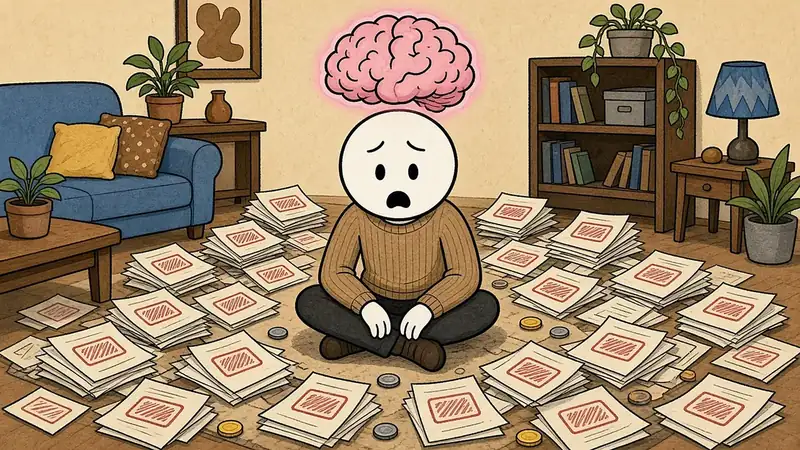
You can explain compound interest to a stranger at a bus stop. You run the spreadsheets at work, and friends ask you to check their numbers. And still, a few days before payday, you find yourself opening the banking app in the shop before you dare tap the card for groceries. If that stings, you are in good company, and the company is smarter than you would guess.
Being clever feels like it should settle the money question. It does not. The link between a sharp mind and a healthy bank balance is far weaker than almost everyone assumes, and the reasons are more interesting than "just try harder."
Short answer: Smart people are often bad with money because intelligence mostly helps you earn, not keep. A higher IQ reliably raises income, but studies find it barely moves net worth or protects against financial distress. Knowing the rules is a different skill from following them, and a clever brain is excellent at talking itself into bad decisions. What actually builds wealth is not raw brainpower, it is a few boring systems that make the right move automatic.

Income is not the same as wealth
Start with the money coming in, because that is where intelligence genuinely helps.
The economist Jay Zagorsky looked at a large American study that followed thousands of people for decades and gave each of them an IQ-style test. He found that each extra IQ point was worth a meaningful bump in annual income, a few hundred dollars per point in his data. So far, so expected. Smart pays, on the salary line.
Then he looked at wealth, meaning net worth, the stuff you actually keep after the bills. Once he compared people with similar backgrounds, the clear income link mostly vanished. Higher IQ did not reliably translate into a bigger pile of saved money.
Stranger still was financial distress: the missed payments, the maxed-out cards, the bankruptcies. These did not fall in a neat line as IQ rose. In some of the data the high scorers were just as likely to be in trouble, sometimes more so. Being the smartest person in the room was no insurance against a spiral.
Call the space between those two things the Keep Gap: the distance between what your brain helps you earn and what it helps you hold on to. For a lot of clever people, the earning line climbs nicely while the keeping line stays flat.
| What a high IQ reliably helps with | What actually builds lasting wealth |
|---|---|
| Landing a higher salary | Moving money to savings before you can spend it |
| Understanding compound interest | Having a buffer so one bad month doesn't sink you |
| Passing exams and interviews | Deciding your money rules in advance, while calm |
| Analysing a complicated problem | Letting good defaults run on autopilot |
| Winning an argument about money | Noticing when your own brain is rationalising |
Read that table top to bottom and the pattern is clear. The left column is about thinking. The right column is about doing the same quiet thing over and over. They are not the same muscle, which is the whole story of this article.
Why knowing the rules isn't following them
The obvious fix for a money problem is education. Learn more, do better. It is the reflex of every smart person: find the right book, understand the system, win.
The researchers Annamaria Lusardi and Olivia Mitchell built three plain questions to test the basics, covering compound interest, inflation, and spreading risk. The "big three" of money literacy. When they asked large samples of adults, only about a third got all three right. So the gap is real, and the obvious conclusion is that people simply need teaching.
Except the teaching barely works. A large meta-analysis by Daniel Fernandes, John Lynch, and Richard Netemeyer pooled hundreds of studies on financial education and found that it explained only a tiny slice of the variation in how people actually behave with money, on the order of a fraction of one percent. Worse, whatever effect there was tended to fade within months. Courses, classes, and pamphlets make almost no lasting dent in behaviour.
This is strangely freeing. You are not behind because you skipped a class, and you will not fix your finances by cramming harder. The same body of research hints at what does help: small, well-timed nudges right at the moment of a decision, not a lecture six months before you need it.
Take Sam, a hypothetical reader who is good at their job. Sam has read three money books and can recite the advice, but has never set up an automatic savings transfer, because it felt too small and obvious to bother with. Sam knows everything and does nothing. That is not a knowledge problem. It is the gap between knowing and doing, and no amount of cleverness closes it on its own.
Your clever brain is a very good defence lawyer
Here is the uncomfortable part. A sharp mind does not just fail to protect you from bad money decisions. Sometimes it helps you commit them more confidently.
Researchers Richard West, Russell Meserve, and Keith Stanovich tested people for the "bias blind spot," the habit of spotting flaws in everyone else's thinking but not your own. You might hope that more cognitively sophisticated people would have a smaller blind spot. They did not. If anything, higher ability went with a slightly bigger one. Being smart made people better at seeing bias in others and no better at seeing it in themselves.
Now watch it with real money. Brad Barber and Terrance Odean studied tens of thousands of households at a brokerage. The investors who traded the most, confident they could beat the market, earned noticeably less than the market returned. Their overconfidence cost them several percentage points a year, every year. They were not stupid. They were sure, and sureness is expensive.
Want the extreme version? A famous hedge fund run partly by two Nobel laureates collapsed and lost billions of dollars in a matter of months, and it took a consortium of banks to contain the fallout. Credentials on the letterhead did not save it.
And this is not new. Three centuries ago Isaac Newton, one of the greatest minds who ever lived, sold his shares in the South Sea Company at a tidy profit, then watched everyone around him keep getting rich, bought back in near the top, and lost a fortune. A famous line has him saying he could calculate the motions of the heavens but not the madness of people. He probably never actually said it, but the lesson survives the misquote. (The mathematician Andrew Odlyzko has reconstructed Newton's South Sea trades in detail from the surviving records.)
A big brain does not delete your biases. It just hires them a better lawyer, one who can build a convincing case for whatever you already wanted to do.
When money is tight, the brain pays a tax
Before the fixes, one more twist, and this one is not your fault.
A team led by Anandi Mani studied sugarcane farmers in India, testing the same people twice: once before harvest, when money was scarce, and once after, when they had been paid. Before harvest, under the weight of money worry, they scored measurably worse on reasoning tasks. The researchers estimated the gap was large, comparable to a meaningful drop in IQ points. Same farmers, same brains, just under financial pressure.
The honest footnote: a later study by Leandro Carvalho, Stephan Meier, and Stephan Wang ran a similar test around payday for lower-income American households and did not find the same drop. So the effect is debated. But the direction matches something you have probably felt: when the account is low, it is genuinely harder to think straight.
If stress eats mental bandwidth, then the first fix for "smart but broke" is not a cleverer plan. It is a buffer, a cushion of cash that gives your brain room to work. You cannot out-think a problem while the problem is busy renting out your attention.
What actually predicts who keeps their money
So if it is not IQ, and it is not education, maybe it is willpower. Nice idea. The research mostly points elsewhere.
One clue comes from a long New Zealand study led by Terrie Moffitt and colleagues, which followed around a thousand children from birth into their thirties. Childhood self-control, measured when they were young, predicted their adult financial health, and the link held even after accounting for IQ and family background.
That sounds like a verdict in favour of willpower. It is not, and here is the twist. The people who end up fine are generally not white-knuckling their way through every temptation. They have set things up so that temptation rarely gets a vote.
Three findings make the point:
- Planning beats patience. John Ameriks, Andrew Caplin, and John Leahy found that people with a higher "propensity to plan," who actually track where the money goes, accumulate more wealth, and it is not explained away by income or by being naturally patient.
- Defaults do the heavy lifting. Brigitte Madrian and Dennis Shea studied a company that switched its pension sign-up from opt-in to automatic. Under opt-in, a minority joined. Flip it to automatic, and the large majority stayed enrolled. Same jobs, same pay, different default.
- Future-you is an easier sell. Richard Thaler and Shlomo Benartzi's "Save More Tomorrow" plan asked workers to commit future pay rises to saving. Over a few years their savings rate climbed dramatically. Nobody became more disciplined. The system did the work.
So here is a definition worth keeping. Financial intelligence is the skill of turning income into lasting security, mostly through systems and behaviour, not IQ. It is less about how fast you think and more about what you have arranged to happen without thinking. (This is the same quiet pattern behind the people in our earlier video, The Psychology of People Who Quietly Get Rich (And Never Look It).)
Common myths that keep smart people broke
A few beliefs do most of the damage. If you recognise one, that is the point.
- "I understand money, so I'm fine." Understanding is the left column of that table. Keeping is the right column. They come apart constantly.
- "I'll sort it out once I earn more." High income with no savings is one of the most common versions of smart-but-broke, usually because spending quietly rises to match the raise. That slow leak has a name, and we wrote a whole piece on it: lifestyle creep.
- "I just need more willpower." Willpower is least reliable exactly when you need it: when you are tired, stressed, or rushed. Systems do not get tired.
- "The problem is big financial decisions." Often it is the small autopilot ones: the subscriptions, the renewals, the loyalty premium you pay for never switching. That is the loyalty penalty, and smart people pay it as happily as anyone.
- "Being good with money means being frugal and miserable." No. It mostly means deciding once, in advance, so you are not re-litigating every purchase with a tired brain at 11pm.
The Smart-but-Broke Self-Check
Before the fixes, a quick diagnostic. Count how many of these are true for you right now:
- You could explain good money habits to someone else, but you have not set them up for yourself.
- Your income has gone up over the years, but your savings have not really followed.
- You have no automatic transfer moving money to savings on payday.
- A surprise bill of a few hundred (pick a number that would hurt) would mean borrowing or real stress.
- You make money decisions in the moment, not against rules you wrote in advance.
- You tell yourself you will "get serious about it" once some future condition is met.
Three or more, and the issue almost certainly is not your intelligence. It is your setup. Which is good news, because a setup is something you can change this week.
The 5-rule setup: what to actually do
None of these need a high IQ. That is the point. Do them in order.
- Pay yourself first, automatically. Set up a standing transfer for the day after payday, before the money is available to spend. Start small if you must. As an example, if you take home the equivalent of 3,000 a month, a 5 % transfer is 150, moved to a separate account while you sleep. You never see it, so you never miss it.
- Build the buffer before anything clever. Forget investing for a moment. First get a starter cushion (a few hundred of your currency), then build toward about one month of expenses. This is the buffer that gives your brain room under pressure. These figures are rules of thumb, not precise targets.
- Save more tomorrow. Decide today that your next pay rise lifts your saving rate by one percentage point. You do not miss a raise you never started spending. Lock in the future while it is still cheap and painless.
- Write your money rules on one page. Decide while you are calm, not while you are tempted. For example: a 48-hour wait on any non-essential purchase over a set amount; check investments at most once a month; and never make a big money decision while tired, angry, or rushed. You are writing a contract with your future self.
- Use the Friend Test. Before any big decision, ask what you would tell a friend in your exact situation, and say it out loud in the third person. Igor Grossmann and Ethan Kross found that people reason more wisely about someone else's problem than their own. (Their study was about relationship dilemmas, so treat this as a borrowed trick, not proof about money.) Distance makes you smart.
You do not have to out-think the problem. You just have to out-build it. The smartest money move you make will not feel smart at all. It will feel like one quiet transfer you set up once and then forgot you ever made.
Key terms
- Financial intelligence: The skill of turning income into lasting security through systems and behaviour rather than raw IQ.
- The Keep Gap: Our term for the distance between what your brain helps you earn and what it helps you hold on to.
- Net worth: What you own minus what you owe; the money you actually keep, as distinct from income.
- Financial distress: Money trouble such as missed payments, maxed-out credit cards, or bankruptcy.
- Bias blind spot: The tendency to spot thinking biases in other people while missing them in yourself.
- Overconfidence: An inflated belief in your own judgement that, in investing, tends to drive excess trading and lower returns.
- Default effect: The strong pull of whatever option is pre-selected, such as automatic pension enrolment, because most people simply stay with it.
- Propensity to plan: A measured tendency to set and track financial plans, linked to greater wealth independent of income.
- Self-distancing: Reasoning about your own problem as if advising someone else, which tends to produce wiser decisions.
- Financial literacy: A working grasp of core money concepts such as compound interest, inflation, and spreading risk.
Frequently asked questions
Does a high IQ actually help with money at all?
Yes, but mainly on the earning side. Research by Jay Zagorsky found that higher IQ reliably predicted higher income. Where it fell down was net worth and avoiding financial distress, which showed little clear link to IQ once backgrounds were matched. Intelligence helps the money arrive. It does very little to make it stay.
Why do smart people make bad financial decisions?
Partly because a sharp mind is good at justifying what it already wants to do. Studies on the "bias blind spot" found that more capable thinkers were no better, and sometimes worse, at spotting their own biases. Add overconfidence, which led the most active investors in one large study to underperform the market, and you get clever people making confident, costly calls.
What is financial intelligence, exactly?
In plain terms, it is the skill of turning income into lasting security, mostly through systems and behaviour rather than raw brainpower. It looks like automatic saving, a cash buffer, pre-decided rules, and good defaults. It is closer to a set of habits and arrangements than to a number on a test.
Can you be high income and still have no savings?
Very easily, and it is one of the most common forms of smart-but-broke. As income rises, spending tends to rise with it, so the raise disappears into a bigger lifestyle instead of a bigger balance. The fix is to automate saving before the money reaches your everyday account, and to commit future raises to saving in advance.
Is financial education a waste of time?
Not a waste, but a weak lever on its own. A large meta-analysis found that financial education explained only a tiny fraction of actual financial behaviour, and the effects tended to fade within months. Knowledge helps most when it arrives as a small nudge right at the moment of a decision, and when it is backed by automatic systems rather than willpower.
How do I stop my clever brain from talking me into bad money moves?
Decide the rules in advance, while you are calm, and write them down so the tired, tempted version of you cannot renegotiate. Then add distance: ask what you would advise a friend in the same spot. Both tactics work because they take the decision away from the in-the-moment brain that is so good at building a convincing case for the wrong thing.
Sources & methodology
How we researched this: we read the primary sources listed below (peer-reviewed papers via their DOIs, an official Federal Reserve history, and a Royal Society journal article) and quote each number exactly as the source reports it, for the sample and setting that source studied. Where a finding is contested we say so in the text: the poverty-and-cognition result has a mixed replication record, the famous Newton quote is almost certainly apocryphal, and the self-distancing study tested relationship dilemmas rather than money. We do not run our own surveys, and the "Keep Gap", the Smart-but-Broke Self-Check, and the five-rule setup are our own frameworks, not claims from the literature. Several academic publishers block automated requests, so some links may prompt for access; each DOI resolves to the cited article. Spot a mistake? Email us and we will fix it.
- Jay L. Zagorsky, Do you have to be smart to be rich? The impact of IQ on wealth, income and financial distress, Intelligence. DOI
- Annamaria Lusardi and Olivia S. Mitchell, The Economic Importance of Financial Literacy: Theory and Evidence, Journal of Economic Literature. DOI
- Daniel Fernandes, John G. Lynch Jr. and Richard G. Netemeyer, Financial Literacy, Financial Education, and Downstream Financial Behaviors, Management Science. DOI
- Richard F. West, Russell J. Meserve and Keith E. Stanovich, Cognitive Sophistication Does Not Attenuate the Bias Blind Spot, Journal of Personality and Social Psychology. DOI
- Brad M. Barber and Terrance Odean, Trading Is Hazardous to Your Wealth, The Journal of Finance. DOI
- Federal Reserve History, Near Failure of Long-Term Capital Management. federalreservehistory.org
- Andrew Odlyzko, Newton's financial misadventures in the South Sea Bubble, Notes and Records of the Royal Society. DOI
- Anandi Mani, Sendhil Mullainathan, Eldar Shafir and Jiaying Zhao, Poverty Impedes Cognitive Function, Science. DOI
- Leandro S. Carvalho, Stephan Meier and Stephan W. Wang, Poverty and Economic Decision-Making: Evidence from Changes in Financial Resources at Payday, American Economic Review. DOI
- Terrie E. Moffitt et al., A gradient of childhood self-control predicts health, wealth, and public safety, Proceedings of the National Academy of Sciences. DOI
- John Ameriks, Andrew Caplin and John Leahy, Wealth Accumulation and the Propensity to Plan, The Quarterly Journal of Economics. DOI
- Brigitte C. Madrian and Dennis F. Shea, The Power of Suggestion: Inertia in 401(k) Participation and Savings Behavior, The Quarterly Journal of Economics. DOI
- Richard H. Thaler and Shlomo Benartzi, Save More Tomorrow: Using Behavioral Economics to Increase Employee Saving, Journal of Political Economy. DOI
- Igor Grossmann and Ethan Kross, Exploring Solomon's Paradox: Self-Distancing Eliminates the Self-Other Asymmetry in Wise Reasoning, Psychological Science. DOI
Education only, not financial, investment, tax or legal advice. Found an error? Email coinandcortex@gmail.com and we'll fix it.
Keep reading
-
Start here
Lifestyle Creep: Why Earning More Doesn't Make You Richer (and How to Stop It)
Lifestyle creep quietly eats every raise you earn. Learn why it happens and a simple rule to keep more of your money without feeling deprived.
-
Start here
Personalized Pricing: Why You and Someone Else Pay Different Prices for the Same Thing
Personalized pricing means two shoppers can pay different prices for the same item. See how it works, what the evidence shows, and six ways to pay less.
-
Start here
Why Do We Work 40 Hours a Week? The Surprising History (and What It Means for Your Money)
Why do we work 40 hours a week? The real history of the 40-hour week, why Keynes's 15-hour prediction flopped, and how to price your time in life-hours.