How to Negotiate Lower Bills: Calm Scripts for Internet, Phone and Insurance
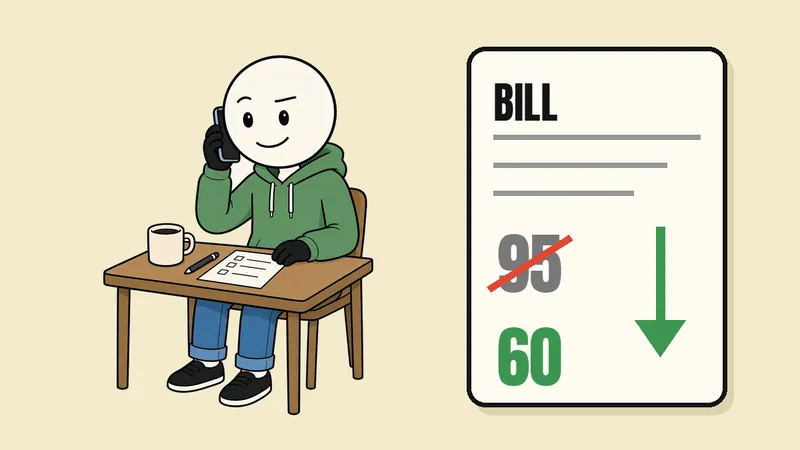
Your broadband promo ends and the bill quietly jumps. Your insurance renewal lands a little higher than last time. Somewhere in the back of your mind you know you could probably talk it down with one phone call, and somewhere a bit further back, you really don't want to make that call.
This is the guide to that exact moment: not the once-a-year routine, but the conversation itself. What to say, in what order, when to stop talking, and what to do when the person on the other end says no. Calm, honest, and genuinely usable, with no magic phrases.
Short answer: To negotiate a lower bill, get one real benchmark price (a new-customer deal, a rival quote, or your provider's own best tariff), then call or message your provider and ask them to match or beat it. Lead with the benchmark, make one specific ask, then stop talking and let them respond. Only mention leaving if you genuinely would, and get any agreed price and end date in writing. It works most reliably at the end of a contract, when you are out of contract, or just after a price rise.

The short video above explains why your neighbour can pay less than you for nearly the same service, and it ends with a simple routine for fixing it. This article is the close-up on one step of that routine: the call.
Does negotiating your bills actually work?
Yes, more often than people expect, and most reliably around the end of a contract. The companies you buy from have already done the maths, and the maths quietly favours the person who asks.
Here is the asymmetry that puts you in a stronger position than you feel. Winning a brand-new customer costs a provider real money in advertising, discounts and admin. Keeping you is usually cheaper, which is why retention teams exist and why they often have offers you won't see advertised. You are not begging a favour, you are offering the cheaper outcome: to stay.
The evidence that asking pays off is solid, and it comes from a regulator rather than an app that wants your business. In a survey for Ofcom, the UK communications regulator, about half of broadband customers who were in contract said they had negotiated a better deal than the one they were offered or had seen advertised when they signed up. Another one in ten tried and failed. Put differently, most of the people who asked got something.
When UK telecoms providers were required to send end-of-contract notices, Ofcom found that two thirds of customers recalled getting one, 90% of those found it helpful, and a fifth were prompted into action they would not otherwise have taken. The share of broadband customers who re-contracted or switched as their deal ended rose from under half to about six in ten. The people who do nothing are the ones who pay: Ofcom reported that out-of-contract broadband customers paid on average around £5.10 a month more than they needed to. (These are UK figures, used to show the pattern, not a promise about your bill.)
That slow drift upward for loyal customers has a name and a wall of regulator evidence behind it, which we cover in our guide to the loyalty penalty and how personalized pricing lets different customers pay different prices for the same thing.
So why don't more of us ask? Partly because we assume the answer will be no. Psychologists Frank Flynn and Vanessa Lake found that people consistently underestimate how willing others are to agree to a direct request for help. Their experiments were about asking strangers for favours, not about bills, but the instinct is the same one: we brace for a fight that often isn't coming. On top of that sits plain inertia, the status quo bias described by Samuelson and Zeckhauser. The fix is not confidence or charm. It is preparation.
Should you threaten to cancel?
Only if you mean it. "I want to cancel" is a real lever, but it is a loaded one, and bluffing it has two problems. First, some providers will simply start your cancellation, and now you are managing a switch you did not plan. Second, the honest version works nearly as well without the risk. If you would genuinely leave for a better price, say so plainly. If you are not sure, say "I'm reviewing my options" instead, which is true and still signals that you are willing to move.
One rule matters more than any script: never invent a competitor's quote. A made-up offer is often checkable, it can void a deal, and it corrodes the one thing that actually gives you power, which is a real, honest number you can point to.
The Three Numbers: the prep that does the work
Before you pick up the phone, write down three numbers. Get these right and the call almost runs itself, because you are no longer improvising, you are reading off a page.
Call it The Three Numbers.
| # | The number | Where you get it | Why it matters |
|---|---|---|---|
| 1 | What you pay now | Your latest bill or online account, the real monthly figure after any promo ended | This is the problem you are there to fix, stated as a fact, not a feeling |
| 2 | The benchmark | The best real price available to you: a new-customer deal for the same thing, a rival's quote, or your own provider's best tariff | This is your leverage. It replaces "that seems expensive" with "here is the going rate" |
| 3 | Your walk-away number | The price at or below which you will happily stay. Above it, you leave, and you have to mean it | This stops you accepting a weak offer out of relief, and tells you exactly when to end the call |
Meet Sam, our hypothetical bill-payer. Sam's broadband introductory deal has ended and the price has jumped. For example, Sam now pays 45 a month (a made-up number in whatever your currency is), the best new-customer price for the same speed is around 30, and Sam decides anything up to 33 is worth staying for. That is 45, 30, 33. Sam has not even dialled yet and already knows what a good outcome looks like.
Writing them down lets the numbers do the emotional work. You are not haggling, which feels adversarial, you are pointing at the gap between what you pay and what the thing costs, and asking a reasonable question about it.
Where do you find a free benchmark?
Your benchmark is the best real price available to you, and in most markets you can get it free in a few minutes. You do not need an app or a subscription. You need the going rate and, where it exists, a rule that forces the provider to show it to you.
Phone and broadband (UK)
UK rules do a lot of your homework. Providers must send an end-of-contract notification, by text, email or letter, between 10 and 40 days before your deal ends, setting out what you will pay afterwards and the provider's best deals, including prices only available to new customers. Ofcom's guidance says those best tariffs should include the cheapest tariff available to you for the services you have and, if your phone and airtime are bundled, the cheapest SIM-only deal. Out of contract, you get best-tariff information at least once a year. That notice is your benchmark, handed to you.
Switching is easier than the dread suggests, which strengthens your hand. To move mobile provider and keep your number, you text a code request to a short number (in the UK, "PAC" to 65075) and your provider must reply within about a minute, with the switch done in one working day. For broadband, One Touch Switch means you only contact the new provider, who arranges the move, with any loss of service meant to last no longer than a working day. When leaving is that painless, "I'm reviewing my options" carries real weight.
Phone and broadband (EU)
In the EU, the European Electronic Communications Code sets the backstop: a consumer's initial contract commitment cannot exceed 24 months, and the rules are designed so that ending a contract does not act as a disincentive to switching. If your contract rolls over automatically, your provider has to tell you beforehand, in a durable form such as an email or letter, when the commitment ends and how to cancel, and give you best-tariff advice at the same time. After the rollover you can leave at any time with no more than one month's notice, paying only for the service during that month, and you should get best-tariff information at least once a year. National rules vary in the detail, but the principle is the same: once your committed period is over, leaving is cheap, and that is the leverage you bring to the call.
Broadband (US)
In the US, the FCC requires broadband providers to display a standardised "Broadband Facts" label, a bit like a nutrition label. It shows the monthly price, whether that price is an introductory rate and what you will pay once it ends, the contract length, the fees, and any early termination fee. That post-promo number is the one that matters, and comparing two labels side by side gives you an instant benchmark.
Insurance (home and car)
Insurance works differently, and the difference changes your tactics. In the UK, FCA rules require home and motor insurers to offer renewing customers a price no higher than they would pay as a new customer through the same channel. So asking your own insurer for "the new-customer price" gets you nowhere there, because the rule already bars them from charging you more than it. The FCA itself notes that you can still benefit from shopping around or negotiating; the leverage is simply different. It is a genuine quote from a rival, plus changing what you buy: adjusting your excess or deductible, trimming add-ons you do not use, or paying annually instead of monthly where monthly carries an interest charge.
Elsewhere, including the US and much of the EU, renewal pricing rules differ, and an insurance price is mostly built from risk inputs and discounts rather than a number an agent can freely slash on the phone. There, "negotiating" really means an annual policy review plus shopping around: re-quote with a couple of rivals, ask what discounts you qualify for, and use the best quote as your benchmark.
A calm playbook for each bill
The structure is the same everywhere: lead with your benchmark, make one clear ask, pause, then confirm in writing. What changes is the specific ask. Keep every script short and human. You are asking a reasonable question, not performing.
Internet and broadband
Your strongest moment is the end of the contract or just after a price rise. Open with the benchmark and a single, specific request.
"Hi, my contract has ended and my price has gone up to [number 1]. I can see your current new-customer price for the same speed is [number 2]. I'd like to stay, so can you bring me down to match that?"
Then stop talking. If the first offer is weak, do not argue it, just restate your walk-away number: "That's still above what I'm seeing elsewhere. The most I'd want to pay to stay is [number 3]."
Mobile phone
The big, common overcharge is paying a bundled price long after the handset is paid off. Once the phone is yours, the airtime is all you are buying, and a SIM-only plan is usually far cheaper. In the UK, Ofcom's guidance says your provider's best-tariff information should include the cheapest SIM-only deal for the services you have, for exactly this reason.
"Hi, I've finished paying off my handset, but my monthly price hasn't changed. I'd like to move to a SIM-only plan that reflects that. What's the best SIM-only rate you can offer me to stay?"
If they can't beat a good SIM-only deal elsewhere, this is one of the easiest switches to make, so you can say "I'm reviewing my options" and mean it.
Home and car insurance
Here the lever is a rival quote and the shape of the policy, not a plea to an agent.
"Hi, I've had my renewal and I've got a like-for-like quote from another insurer for [number 2]. Before I move, can you match it, or suggest changes to my cover or excess that would get me there?"
Never cancel the old policy until the new cover has started. A gap in cover can cost far more than any saving if something goes wrong in between.
What you usually can't haggle
Some bills do not bend, and knowing which saves a frustrating call. Regulated or metered utilities are usually priced by a set tariff or by how much you use, so the only lever is choosing a cheaper tariff or supplier where that is allowed. Streaming and software subscriptions are similar: the lever is changing tier, pausing, or cancelling, not a discount call. For those, decide whether you still want it rather than haggling.
If you'd rather have these scripts, a tracker, and the reminders ready to go instead of building them yourself, that is what the Switching Day Kit is for.
What is a retention offer, and is it a good one?
A retention offer is a deal a provider makes to keep you once you signal you might leave. It is usually a discount or perk the retention team can authorise that the marketing page doesn't show. The catch is that not every retention offer is actually a saving, so you have to read it properly.
Regulators know these conversations happen. Ofcom's guidance openly recognises that some customers get in touch about leaving precisely to hear what offers are available, and calls this a "retention conversation". It also says that if you just want to leave, providers should not drag you through one: agents should process the request promptly. So you can ask for the offer, or decline it, and both are legitimate.
Retention offers usually take one of these forms:
- A lower recurring monthly rate.
- A re-contract at a fresh promotional rate (often with a new minimum term).
- A one-off bill credit, applied once to your account.
- Extra speed, data, or a perk at the same price.
- A waived fee, such as a setup or upgrade charge.
To judge any of them, work out the total cost over the full term, including what happens when the deal ends. Four questions cut through most of it: Is this a recurring cut or a one-off credit? Does it start a new lock-in with an early termination fee? Is the "offer" actually an upsell (more stuff, same or higher cost) rather than a saving? And what will I pay when this promo expires?
Here is Sam again, with clearly made-up numbers. Sam's bill is 45 a month and the benchmark is 30. The retention agent offers two things. Option A: keep the 45 rate but take a one-off bill credit of 60 as a goodwill gesture. Option B: a new 12-month deal at 32 a month.
Over a year, Option A costs 45 times 12, minus the 60 credit, which is 480. Option B costs 32 times 12, which is 384. Option B is about 96 cheaper over the year, and it keeps saving after that, while the one-off credit is spent once and gone. The credit feels generous because it is a bigger single number, but the recurring cut wins. Sam takes Option B, nudges once toward the 30 benchmark, lands at 32, and stops, because 32 is inside the walk-away number.
What to say when they say no
The first "no" is rarely the end, it is usually the start of the real conversation. Stay calm, don't fill the silence, and have a reply ready for each common line.
| They say | What it usually means | What you say |
|---|---|---|
| "That's the best I can do." | It may be the best they can do at their desk, not the company's final price | "I understand. Can you put me through to retention, or note on my account what you've offered and that I'm deciding whether to switch?" |
| "You're still in contract." | True, so timing is your issue, not price | "Thanks, I'll call back in the last month of my term. Can you note my file?" |
| "That offer is only for new customers." | They're testing whether you'll accept the gap | "I'd rather not switch to get it, but I will if I have to. Is there a loyalty or retention price?" |
| "I can add speed/data instead." | An upsell dressed as a win | "I don't need more, I need a lower price. Can we focus on the monthly cost?" |
| "I can give you a one-off credit." | Cheaper for them than a recurring cut | "I appreciate it, but I'm after a lower ongoing rate. What's the best monthly price you can do?" |
| "Let me transfer you..." (loop) | You've hit a dead end for today | "No problem. I'll try again another day, or by chat. Thanks for your help." |
If two attempts get you nowhere and you have a genuinely better benchmark, the answer is not to push harder, it is to switch. The willingness to walk is what made the ask credible in the first place.
Common myths and mistakes
Myth: there's a magic phrase. There isn't. What works is a real benchmark, a specific ask, and a pause. Scripts help you stay calm, but no sentence hypnotises a call centre.
Myth: you have to be aggressive. The opposite. Warm and specific beats loud and vague every time. You are making it easy for someone to say yes, not winning an argument.
Mistake: bluffing a competitor offer. It can be checked, it can void a deal, and it burns your credibility. The true going rate is leverage enough.
Mistake: accepting the first number. First offers are opening positions. Research on negotiation (Galinsky and Mussweiler) shows the first number named tends to anchor where things land, which is exactly why you, not they, should put the benchmark on the table first, and why you should let a weak first offer sit in silence.
Mistake: forgetting the new end date. A great new deal becomes next year's loyalty penalty if you don't diarise when it expires. The saving is only real if you remember to defend it again.
How to negotiate a lower bill, step by step
You can run the whole thing in well under half an hour. Prep is ten focused minutes; the call is usually shorter than you fear.
- Prep your Three Numbers (about 10 minutes). Find what you pay now, get your benchmark (new-customer price, a rival quote, or the provider's best tariff), and decide your walk-away number. Write all three down where you can see them.
- Pick your moment. The best leverage is at the end of a contract, when you are out of contract, or just after a price rise. If you are mid-term, note the date and call in the last month.
- Open with the benchmark, then make one ask. State what you pay, state the going rate, and ask them to match or beat it. One clear request, not a list.
- Pause. This is the step everyone skips. After you ask, stop talking and let them respond. Silence is doing your negotiating for you.
- Work the "no." Use the table above. Decline upsells and one-off credits if you want a recurring cut, and restate your walk-away number calmly.
- Confirm in writing. Get the agreed price, what is included, any new term, and the new end date, by email, chat transcript, or your account. "In writing" is what turns a friendly promise into a deal.
- Check the next bill, then calendar the end date. Make sure the new price actually lands, then set a reminder for when it expires so you can do this again before you drift.
Hate phone calls? You are not obliged to make one. Live chat and email can reach the same retention offers, give you a written record automatically, and let you take your time over the script. Ofcom's guidance even lists offering ways to end a contract without speaking to anyone, such as email, letter or an online account, as good practice. For many people that is the better channel, not a lesser one.
This single call fits inside a bigger, calmer habit: batching every contract into one short session a year. For that routine, and the reasoning behind it, see the yearly loyalty penalty plan and our free Fair Price Protocol.
Key terms
- Retention offer: A deal a provider makes to keep a customer who signals they might leave, often better than any advertised price.
- Retention team: The department authorised to give those keep-you discounts, usually reached by saying you are thinking of leaving or cancelling.
- Introductory / promotional rate: A low starter price that applies for a set period, after which the bill rises to the standard rate unless you act.
- Out of contract: When your minimum term has ended and you are free to leave at any time, which is also when prices tend to drift upward if you do nothing.
- Early termination fee: A charge for leaving a contract before its minimum term ends, which can wipe out the saving from switching early.
- Bill credit: A one-off amount knocked off your account, which is spent once, unlike a recurring reduction in your monthly rate.
- Benchmark: The best real price available to you for the same thing, used as the anchor for your ask.
Frequently asked questions
What is a retention offer and how do I get one?
A retention offer is a discount a provider gives to keep a customer who might otherwise leave, and you get one by signalling, honestly, that you are weighing up your options. Ask to speak to the retention or "customer loyalty" team, lead with a real benchmark price, and request a specific lower rate. The offers are real and can beat anything advertised, but they are only worth taking if the total cost over the full term actually beats your benchmark.
Should I threaten to cancel to lower my bill?
Only if you would genuinely go through with it. A real willingness to leave is powerful leverage, but a bluff can backfire if the provider simply starts your cancellation, and it is unnecessary. Saying "I'm reviewing my options" is honest, keeps your position strong, and avoids triggering a switch you did not plan. Never invent a rival's quote to apply pressure.
How do I negotiate a lower internet bill?
Get the current new-customer price for the same speed, or your provider's own best-tariff notice, then call or message and ask them to match it. Your best leverage is at the end of your contract or just after a price rise. Make one clear ask, pause for their response, decline upsells if you want a cash saving, and get the new price and end date in writing.
What should I say to lower my phone bill?
If your handset is paid off but your bill has not dropped, that is your opening: ask to move to a SIM-only plan that reflects it. Say something like, "I've finished paying for my phone, so I'd like a SIM-only price that matches that. What's your best rate to keep me?" Providers' best-tariff information is meant to include a comparable SIM-only option, and these switches are among the easiest if they won't budge.
Can you negotiate insurance premiums?
Partly, and it depends where you are. In the UK, rules require insurers to offer renewing customers a price no higher than a new customer would pay, so the lever is a genuine rival quote plus changing your cover, excess or deductible, or how you pay. Elsewhere the price is built mostly from risk and discounts, so "negotiating" is really an annual review and shopping around. Either way, never cancel old cover before the new policy starts.
Is it better to haggle or just switch?
Both work, and the right move depends on your numbers. If a real rival price is far below your renewal and switching is easy, switching often wins and takes less talking. If you would rather stay, hold that price and ask your provider to match it, since retention teams often have offers they don't advertise. The deciding factor is a genuine benchmark, and a genuine willingness to walk. Chat and email reach the same retention discounts if a phone call feels like too much.
Sources & methodology
How we researched this: we read the primary sources below and confirmed each number in the original regulator page, report, or paper, quoting figures as reported for the market and period each one covers. The UK figures are used to show the mechanics and scale of bill negotiation, not as a price for your own contract. We do not run our own surveys. The Three Numbers framework and the scripts are our own. If you spot anything that needs correcting, email us and we will fix it.
- Ofcom (Kantar Media omnibus research), Decision makers engagement in the broadband market. Slide pack (PDF)
- Ofcom, Telecoms customers saving millions as Ofcom rules bed in. ofcom.org.uk
- Ofcom, Are you in or out of contract?. ofcom.org.uk
- Ofcom, Guidance under General Condition C1: contract requirements (end-of-contract and annual best tariff notifications; contract termination and retention conversations). Guidance (PDF)
- Ofcom, Switching mobile phone provider. ofcom.org.uk
- Ofcom, Switching broadband provider (One Touch Switch). ofcom.org.uk
- European Union, European Electronic Communications Code (EU directive), Article 105: contract duration and termination. legislation.gov.uk
- US Federal Communications Commission, Broadband Consumer Labels. fcc.gov
- US Federal Communications Commission, Broadband Labels Glossary. fcc.gov
- UK Financial Conduct Authority, FCA confirms measures to protect customers from the loyalty penalty in home and motor insurance markets. fca.org.uk
- UK Financial Conduct Authority, PS21/5: General insurance pricing practices market study, feedback to CP20/19 and final rules. Policy statement (PDF)
- UK Competition and Markets Authority, Tackling the loyalty penalty. gov.uk
- Flynn, F. J. and Lake, V. K. B., If You Need Help, Just Ask: Underestimating Compliance With Direct Requests for Help, Journal of Personality and Social Psychology. DOI: 10.1037/0022-3514.95.1.128
- Galinsky, A. D. and Mussweiler, T., First Offers as Anchors: The Role of Perspective-Taking and Negotiator Focus, Journal of Personality and Social Psychology. DOI: 10.1037/0022-3514.81.4.657
- Samuelson, W. and Zeckhauser, R., Status Quo Bias in Decision Making, Journal of Risk and Uncertainty. DOI: 10.1007/BF00055564
Education only, not financial, investment, tax or legal advice. Found an error? Email coinandcortex@gmail.com and we'll fix it.
Keep reading
-
Start here
Personalized Pricing: Why You and Someone Else Pay Different Prices for the Same Thing
Personalized pricing means two shoppers can pay different prices for the same item. See how it works, what the evidence shows, and six ways to pay less.
-
Do Prices Change Based on Your Browsing History? What the Evidence Actually Shows
Do prices change based on your browsing history? The evidence: mostly no for the same item, sometimes at a few sellers, plus a two-minute test to check.
-
The Fair Price Protocol: a six-step habit to stop overpaying
A plain-English look at personalised and dynamic pricing, the loyalty penalty, and a simple six-step habit to get a fair price.
-
The Loyalty Penalty: Why Loyal Customers Pay More (and How to Stop It)
The loyalty penalty means long-standing customers often pay more than new ones. Learn why it happens and how to stop overpaying on your bills.